Nobody takes a job because they want to be in charge of office catering. Yet somehow it lands on someone’s desk: the office manager, the PA, the newest person in the team, or whoever made the mistake of saying “I’ll sort it” in a meeting. Suddenly they are counting vegetarians, guessing how many sandwiches thirty people eat and hoping the food turns up before the client does.
Office catering does not need to be stressful. We have been making sandwiches since 2009 and now cater for businesses, venues and events across England and Wales, from boardroom lunches to conference days. The offices that find it easy all follow the same handful of habits, and here they are.
The two terms overlap, but they usually describe different jobs. Office catering tends to mean food delivered to your workplace: meeting lunches, training days, team breakfasts and regular staff lunches. Corporate catering is broader and covers business events wherever they happen, including conferences, product launches, client hospitality and away days.
The principles are the same for both. Know your numbers, know your dietary requirements, order early enough and choose a supplier who turns up on time. What changes is the scale and the presentation.
Most office food orders fall into one of four categories, and each needs a slightly different approach.
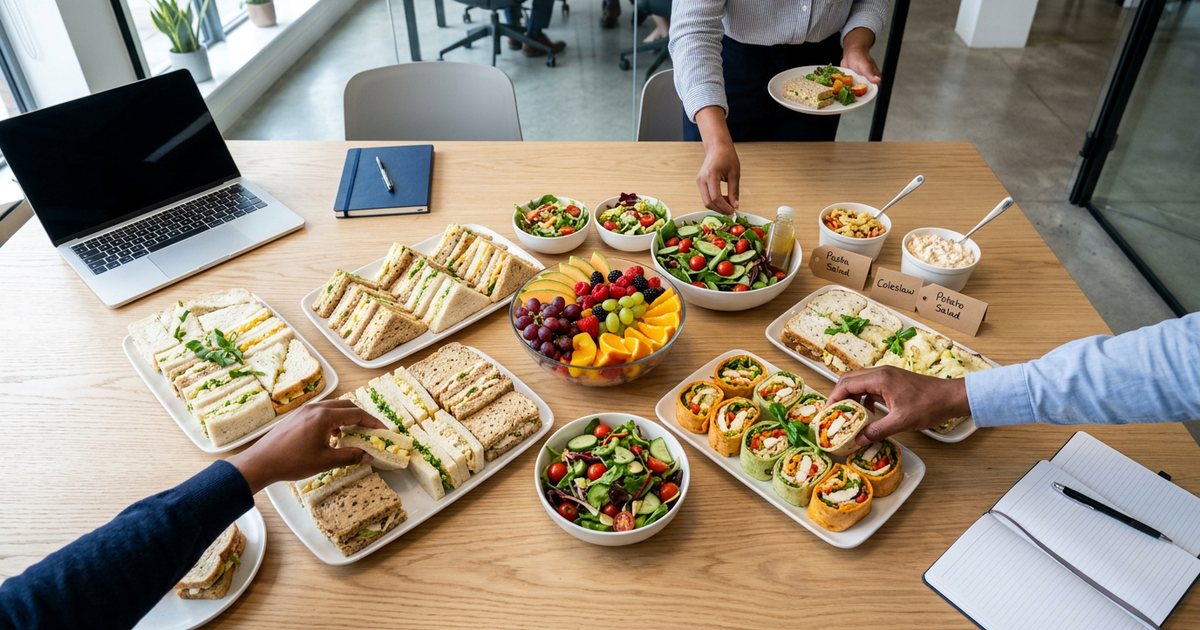
Meeting and working lunches are the most common. The food needs to be easy to eat while talking, with no cutlery and nothing that drips onto a laptop, so sandwiches, wraps and platters are the practical choice. Our sandwich platters buyer’s guide covers quantities and fillings in detail.
Regular staff lunches are a growing perk. Some businesses provide lunch every Friday, others once a month, others every day. Here variety matters more than presentation, because the same people are eating the same supplier’s food week after week.
Client and board meetings call for a step up. A well-planned boardroom lunch quietly says something about your business before anyone opens a slide deck. This is where premium options earn their money. Our Signature range uses hand-picked ingredients and more inspired combinations for exactly these moments.
Big internal events, such as all-hands meetings, training days and celebrations, need volume, variety and reliable timing above everything else.
A free lunch is one of the simplest perks a business can offer, and one of the most noticed. It gets people away from their desks, gives teams a reason to eat together and costs far less per person than most benefits.
If you are considering regular office lunch delivery, start small. A monthly team lunch is a good trial: easy to budget, easy to organise and easy to scale up if it works. Rotate the menu so it never feels like a routine, keep some lighter options in the mix, and ask the team what they would like. You will learn more from one quick poll than from a month of guessing, and you will soon find the favourites people keep asking for.
Standing orders make life easier on both sides. When a supplier knows you need food every Friday for forty people, they can plan production around it, and you can stop placing the same order every week. For sites that run shifts or want food available outside lunchtime, a sandwich vending machine can fill the gaps between catered lunches.
Not every catering order is lunch. Training days, early client meetings and all-staff briefings often start before nine, and nothing sets the tone better than food waiting on the table when people walk in.
Breakfast catering follows the same rules as lunch, just with different food. Breakfast-style sandwiches such as our all day breakfast filling, bagels, yoghurts, fruit and flapjacks all travel well and need no cooking on site. Add cold coffee or juice and you have a breakfast that keeps a room focused until the mid-morning break. Order with the same 48 hours’ notice, and agree an earlier delivery time so the food arrives before your guests do.
Undercatering is remembered for months. Overcatering is forgotten by the afternoon. For a working lunch, allow around one and a half rounds of sandwiches per person, rising to two if the group is hungry or lunch is the main event. If you are adding sides such as crisps, fruit, salads or cakes, you can trim the sandwich count a little.
Confirm numbers as late as your supplier allows, and always add a small margin for the people who appear from nowhere the moment food arrives.
The easiest way to handle dietary needs is to build the question into the meeting invite. Ask whether anyone has allergies or dietary requirements, such as vegetarian, vegan, gluten free or halal, and give a deadline for replies. That single line saves a great deal of last-minute scrambling.
When you order, pass the details on clearly. A good caterer will label every platter, keep gluten-free and allergen-free options separate, and make sure vegetarian and vegan choices are proper food rather than an afterthought. Our salad and pasta pots ranges help here too, giving guests who avoid bread a real meal rather than a plate of garnish.
Even if nobody replies, plan for at least one vegetarian in every group of ten. It is almost always right.
Office catering budgets work best per head. Decide what you want to spend per person, then choose the format that fits. Classic sandwich platters are the most economical option, mixed platters with sides sit in the middle, and premium selections for client meetings cost a little more.
Two things keep costs under control. First, match the food to the occasion: a two-hour training session does not need the same spread as a board meeting. Second, ask about regular orders. Weekly or monthly bookings are easier for a supplier to plan, and that usually shows up in the price.
Timing is where office catering most often goes wrong, so get the logistics clear before you place an order.
We ask for 48 hours’ notice on catering orders, which gives us time to prepare everything fresh and plan the delivery properly. If you are caught short, ring us anyway and we will tell you honestly what is possible. We deliver Monday to Friday as standard and can accommodate weekend catering when required. There are no fixed delivery slots. Instead we agree a time with you in advance, so the food arrives when you need it, not an hour early or ten minutes late.
Every delivery travels in our own refrigerated vans from our Walsall and West Bromwich hub, so food arrives chilled and ready to serve, whether your office is in Birmingham, Bristol or Cardiff.
When the food arrives, keep it in the fridge until shortly before you need it, if you have the space. The Food Standards Agency advises keeping chilled food out of the fridge for the shortest time possible, and no more than four hours. In practice, that means setting out lunch at noon and clearing anything left by mid-afternoon.
Leftovers that have stayed chilled can be offered round later in the day. Anything that has been sitting out for more than four hours should go in the bin, however tempting it looks at five o’clock.
The same habits scale up to larger corporate catering and event catering. We have supplied venues including Telford Conference Centre and the Coventry Building Society Arena, and we catered S&R Construction’s corporate golf day, providing freshly made sandwiches for players at the start of the event. Whatever the size, the job is the same: agree numbers, agree timings and let the caterer worry about the rest so the day runs smoothly.
If your event needs something out of the ordinary, such as a particular menu, a specific dietary mix or a custom presentation, our Bespoke service is designed for exactly that.
Before you place your next order, run through six quick questions. How many people are coming, and is lunch the main meal of their day? Has everyone been asked about allergies and dietary requirements? Is this a working lunch, a client meeting or a celebration? What is the budget per head? Have you given at least 48 hours’ notice? And where will the food go when it arrives? Answer those six and the rest largely takes care of itself.
How much notice do you need for office catering?
We ask for 48 hours’ notice so everything is prepared and delivered properly. For larger events, more notice helps us plan production and delivery.
Do you deliver office catering outside the West Midlands?
Yes. We deliver across England and Wales from our Walsall and West Bromwich hub, using our own refrigerated vans.
Can you cater for allergies and dietary requirements?
Yes. Tell us the requirements when you order and we will build the right mix, with clear labelling on every platter. If you need halal options, our guide to halal sandwiches explains what to ask about.
Can we set up a regular weekly order?
Yes, and it is often the simplest way to run office lunches. Tell us your headcount and how often you want food, and we will suggest a regular order that fits.
If office catering has landed on your desk, hand the hard part to us. Contact The Sandwich Company with your date, headcount and dietary requirements, and we will take it from there. You can see what other businesses say about working with us on our testimonials page, or read more about how we work on our catering page.