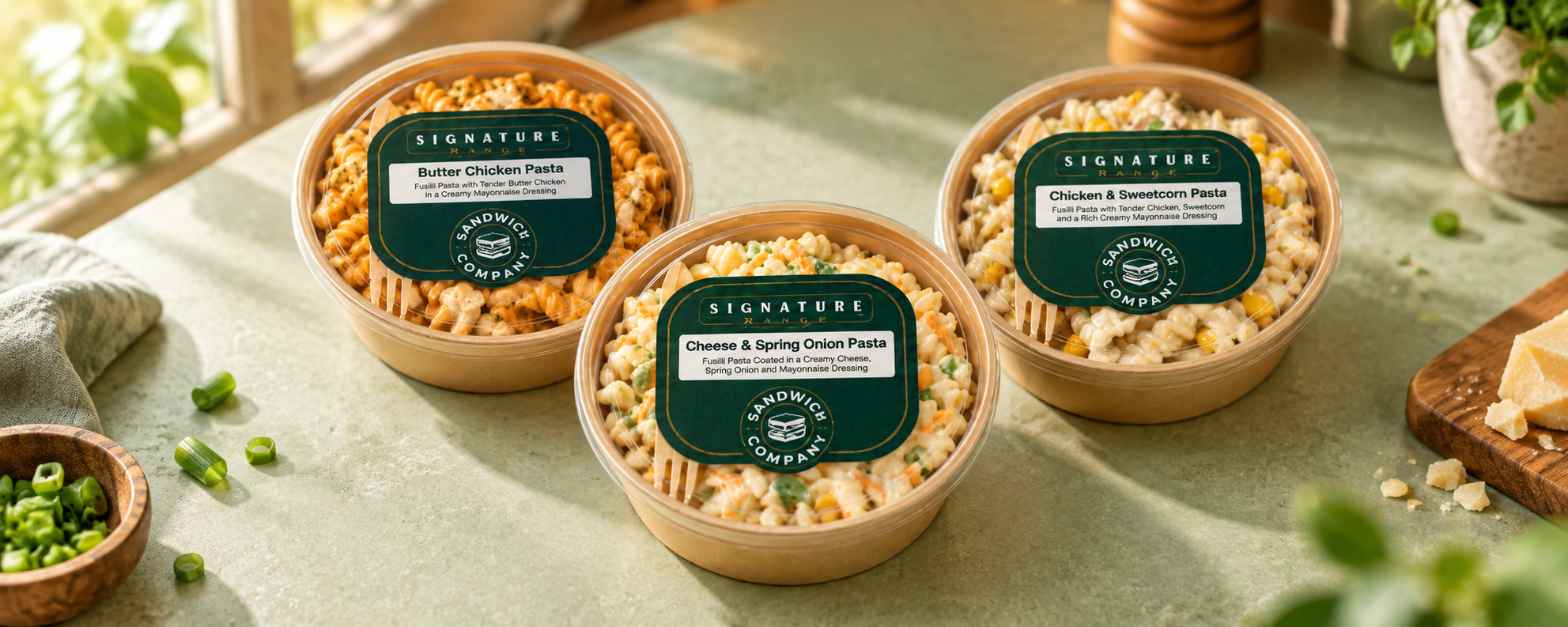
White label products in the UK are products made by one company and sold under another company’s brand; in food, that usually means a specialist manufacturer handles production and food safety while the brand owner controls the branding, range, and sales. Walk down any supermarket chiller and most of what you see was not made by the brand on the pack. It was made by a specialist manufacturer, packed under someone else’s name, and nobody involved thinks that is a secret worth keeping. White labelling is simply how the modern food industry works, and it is no longer reserved for the big chains.
For UK businesses that want to sell food under their own name without building or expanding their own kitchens — from cafe chains, convenience retailers, and coffee shops to gyms, hotel groups, workplace caterers, and established food brands — it offers a faster, more scalable, lower-risk route to market than making everything in-house. We manufacture white label sandwiches and food-to-go for other brands from our West Midlands production hubs, a side of the business that grew sharply after we brought manufacturing fully in house in 2022. This guide explains how white label food products actually work, how the manufacturing and branding process fits together, what drives the cost, how to choose a UK white label manufacturer, how it compares with in-house production, what timelines and risks to expect, and the answers to the questions buyers usually ask before they commit.
A white label product is made by one company and sold under another company’s brand. Unlike services, it is a physical product the customer can assess directly, and the brand owner does not necessarily manufacture it. The manufacturer handles recipes, production, food safety and packing. The brand owner handles the name, the design and the selling. Your customers see your brand; our factory stays invisible.
You will also hear “private label”, which is nearly the same thing. The usual distinction: white label products are made to the manufacturer’s proven recipes and may be offered to multiple companies, while private label products are developed exclusively for one customer. In practice, the terms blur, and most projects sit somewhere in between: a proven base recipe, tuned to your spec, in your packaging, which makes the concept useful for brands that want to launch without building production from scratch. We covered why demand for this is growing so quickly in Why Whitelabel Food Products Are Booming in the UK.
White label food is a great option for businesses that want to launch quickly without taking on the cost and complexity of their own production setup. The range of businesses buying white label products in the UK is wider than most people expect. Cafe chains that want branded sandwiches without building a kitchen operation. Convenience retailers and forecourt groups that want an own-brand range to compete with the multiples. Coffee shops, gyms, hotel groups and workplace caterers that need consistent food at scale. And food brands that have outgrown their own kitchen but are not ready to build a factory. For many of them, selling white label products is a practical route to growth, and the quality of products is critical for long-term success.
The reasons come down to three words: speed, scale and focus. The biggest advantage is getting to market faster than developing from scratch: a white label partner gets you from ideas to shelf in weeks rather than years, and lower minimum order quantities are common, which makes it easier to test a range before committing to full custom development. They also produce at volumes and hygiene standards a small kitchen cannot match, and free you to concentrate on the part you are best at, which is usually the brand and the customers rather than the production line.
Every manufacturer runs the process slightly differently. Ours looks like this, and any good white label food manufacturer in the UK will follow a similar shape.
1. The brief. You tell us what you want to sell, to whom, and at what price point. A forecourt meal deal range and a premium cafe menu are different briefs, and both are fine. Honest volume estimates matter more at this stage than polished decks.
2. Range and recipe development. We propose a range from our existing recipe bank so you can test new ideas before committing to a fully custom product, adapt it to your spec to create a version that fits your brand, or develop something new through our Bespoke service. Using proven, market-tested formulations also reduces risk compared with developing something entirely new from scratch. You taste, we adjust, repeat until it is right.
3. Packaging and labelling. Your branding and logo go on the pack. We handle the legally required part: full ingredient declarations, allergen emphasis, nutrition information, date codes and storage instructions, all compliant with UK labelling law including Natasha’s Law.
4. Production. Your products join our production schedule alongside the sandwiches we make for retail supply across England and Wales. We manage the production process while you keep control of branding and positioning. Same lines, same food safety standards, your name on the pack.
5. Delivery. Our refrigerated fleet delivers to your sites, your depot or your customers, on a schedule that matches how fresh food actually behaves.
From first conversation to first delivery, a straightforward sandwich range typically takes weeks. New product development takes longer, mostly in the tasting and packaging stages.
The honest answer is that overall costs depend on five things, including unit price and production costs, and anyone quoting a number before understanding them is guessing.
Volume is the biggest lever. Manufacturing rewards scale: a daily run of 2,000 units costs far less per unit than a weekly run of 200, because setup, changeover and labour spread across more packs.
Ingredients and spec come next. A cheese and onion sandwich on standard bread and a deli stack on tiger bread are different cost bases, and premium ingredients should show in the retail price as well as the cost price.
Packaging matters more than people expect. Standard skillets with a printed label are the economical route; fully bespoke printed packaging looks superb and adds cost and lead time. In many cases, white label is more cost-efficient than building from scratch, which can save time and money.
Distribution depends on where your sites are and how often they need delivery. One depot drop is cheaper than thirty individual sites.
Development is usually modest for adapted recipes and larger for ground-up NPD with multiple tasting rounds.
The practical advice: come with a target retail price and work backwards. A good manufacturer will tell you quickly whether your numbers stack up, and a trustworthy one will tell you when they do not, while helping you avoid having to invest heavily in facilities or equipment upfront.
Four questions sort reliable suppliers and manufacturers quickly.
Do they own their production? A manufacturer with its own sites, like our West Midlands hubs, controls quality and capacity directly, and established operators often have stronger quality control and compliance systems. Middlemen add margin and risk. Can they handle your growth? Ask what happens if your volumes double, because if the answer involves a pause, you will hit a ceiling at the worst moment. Rigorous vetting matters because product quality and reliability depend on the supplier’s team, production methods, and materials. What is their delivery reach? Fresh food needs a refrigerated network; ours covers England and Wales daily. And who do they already make for? References beat brochures, whether you are comparing any leading supplier or a newer option. Our story since 2009, from three vans to supplying over 900 shops, schools, hospitals and major venues, is the track record and experienced team we put behind every white label conversation.
Plenty of businesses weigh white labelling against producing in house, so it is worth setting the two side by side honestly.
Your own kitchen gives you total control and keeps production margin in the building. It also brings premises, equipment, staffing, food safety accreditation, allergen management, labelling compliance, waste, insurance and the 4am shift when someone calls in sick, especially if you are managing multiple products and services. Those costs are largely fixed: they arrive whether you sell 200 sandwiches or 2,000.
White label manufacturing turns nearly all of that into a variable cost. You pay per unit, the manufacturer carries the fixed overhead across many customers, and one clear advantage is that you do not need to produce everything yourself or carry the fixed cost of production infrastructure. Your risk scales with your sales rather than running ahead of them, and lower minimum order quantities make early testing more practical than building your own kitchen immediately. The break-even point where in-house production becomes cheaper is far higher than most founders assume, and it moves higher still once you price your own time honestly.
The sensible pattern we see: brands start white label, prove the demand, and revisit the question at serious volume, often before moving to your own product or a custom formulation. Many never build the kitchen at all, because by then the margin conversation matters less than the growth one.
For a straightforward branded sandwich range on adapted recipes: expect the brief and tasting rounds to take a couple of weeks, packaging setup one to three weeks depending on how bespoke you go, and first production shortly after sign-off. Call it four to eight weeks from first conversation to first delivery, with fully bespoke NPD adding time at the tasting stage rather than the production one.
The long pole is almost always packaging decisions, so if speed matters, start with standard packs and a printed label, launch, and upgrade the packaging once the range has proved itself on the shelf.
White labelling concentrates your production in one partner, so good quality depends on choosing the right partner and maintaining strong quality control; pick carefully and visit the factory to review how they manage the production process and compliance in practice. Recipes developed exclusively for you should be protected in the agreement, so read it. And date-coded fresh food punishes bad forecasting, so start with a smaller range, learn your sales pattern, then expand. None of these risks argues against white labelling; they argue for doing it with a manufacturer who has done it before so you can realise the benefits with fewer avoidable problems.
What is the difference between white label and private label food? White label: proven recipes offered to multiple brands under their own names. Private label: products developed exclusively for one brand. Most real projects blend the two. For example, while this article focuses on food, white label is also common in groceries, cosmetics, and tech accessories.
Is there a minimum order for white label sandwiches? Yes, because production runs need scale to price sensibly, but ours are set per project rather than off a fixed card. Tell us your expected volumes and we will be straight about whether the numbers work.
Who handles food safety and labelling? The manufacturer. Ingredient declarations, allergen labelling, nutrition data and date coding are all produced by us to UK requirements, with your branding on the pack.
Can I sell white label products under my own brand name? That is the entire point. Your brand appears on the packaging; the manufacturer stays in the background. Brands typically sell through their own website or online store as well as retail channels. SEO helps product visibility online, and organic search drives 43% of ecommerce traffic. Influencer marketing on Instagram and TikTok can help you start selling a new range once it launches and find its place in the wider market. Full details are on our White Labelling page.
If you have a brand, a customer base and an idea of what you want to sell, the rest is our job. Contact The Sandwich Company with your target range, volumes and price point, and we will tell you honestly what it would take to put your name on the pack.